
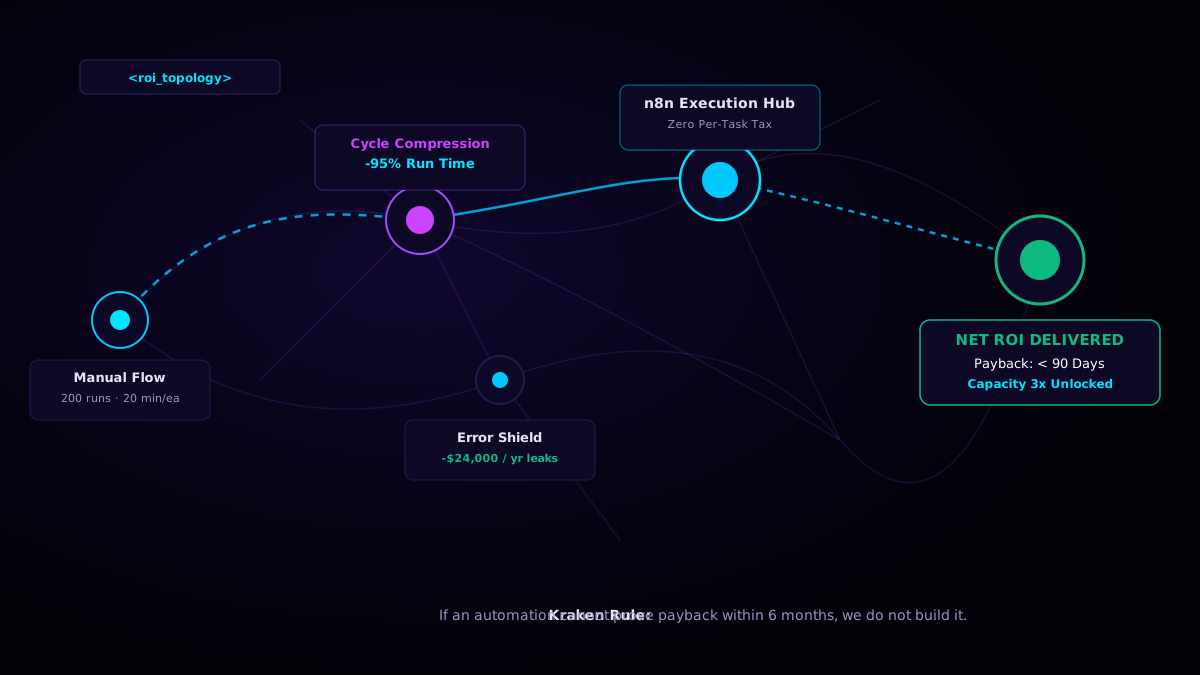
Most teams I meet cannot explain how they measure workflow automation ROI. They know they are "saving time" but they cannot tell me how much, for whom, or what it is worth in dollars.
That is a problem, because automation without a ROI story turns into shelfware, shadow IT, or a graveyard of half-finished workflows.
Recently, No Jitter reported that a majority of IT leaders now see moderate-to-significant ROI from automation and AI initiatives. At the same time, CIO.com reminded everyone: before you automate anything, learn to measure it. I agree with both. The gap between the two is where I spend most of my time with clients.
Here is how I think about workflow automation ROI in my own work at Kraken Automate, and how I suggest clients approach it.
Start with the workflow, not the tool
I build on n8n, but I do not start with n8n. I start with a single workflow that is painful enough to matter and repeatable enough to measure.
- Who does this work today?
- How often does it happen?
- How long does it take end-to-end when it goes well?
- What happens when it goes wrong?
If you cannot answer those questions, you are not ready to talk about AI agents, "hyperautomation" or anything else. You are still in discovery.
This is where I see a lot of AI agent hype crash into reality. Oracle recently asked a good question in their "Agents vs. Workflows: Where Does the ROI Actually Live?" discussion. For most of my clients, the ROI still lives primarily in boring, deterministic workflows: moving data, keeping systems in sync, enforcing rules, triggering the right human at the right time.
A simple ROI model I use with clients
I keep the math simple enough to do on a whiteboard. Here is the basic frame I use for workflow automation ROI:
1. Time saved per run
Take the current average time for the workflow, subtract the automated time, and only count the portion that truly disappears rather than shifting to another person.
- If a manual onboarding checklist takes 20 minutes per customer and the n8n workflow cuts it to 5 minutes of human review, that is 15 minutes of potential savings.
2. Frequency
How many times per month does the workflow run now, and how will that change if you grow?
- If you onboard 200 customers per month, that is 200 runs.
3. Cost of time
I do not use salary as-is. I take a loaded hourly rate (salary plus benefits, roughly 1.3x to 1.5x) and then a utilization factor. The goal is not academic precision; it is consistency across workflows.
4. Annual savings
Time saved per run × frequency × hourly cost × 12. That gives you a rough annual labor savings.
5. Error reduction and risk
This is where the real ROI often hides. How many mistakes does the manual process generate? What does each mistake cost in refunds, discounts, rework, or churn?
- If you reduce billing errors by 10 per month and each error costs you $200 in direct cost or lost goodwill, that is another $24,000 per year you can attribute to the workflow.
6. Cost of automation
Include:
- Implementation time (yours or mine)
- Platform and infrastructure costs
- Maintenance time per month
Shopify recently covered RPA ROI in B2B and wholesale operations and emphasized this same point: if you ignore the cost of keeping automations alive, your ROI numbers will always look better than reality. I see the same pattern in workflow automation.
Where AI fits into workflow ROI
I treat AI as a tool inside workflows, not a replacement for them. Microsoft recently published real-world use cases for how AI can help businesses grow, emphasizing targeted scenarios like personalized outreach, smarter routing, and anomaly detection. That fits my experience: AI adds ROI when it removes ambiguity or manual interpretation inside an otherwise clear workflow.
Examples of where AI blocks can add ROI inside an n8n workflow:
- Summarizing long customer tickets before escalation so support leads spend less time reading and more time deciding.
- Classifying inbound leads and routing them by segment, instead of relying on fragile rule-based filters.
- Extracting structured data from semi-structured documents, so you do not need humans to retype the same fields.
The key is that the workflow is still measurable in the same terms: time, frequency, error rate, risk.
How I decide what not to automate
Automation ROI is not just about what to build. It is also about what to leave manual on purpose.
- Low frequency, high nuance: A quarterly strategic review for a key customer might be painful, but automating it does not change your economics.
- Unstable process: If the workflow changes every month because your product or org is still in flux, you will spend all your time chasing the target.
- Unclear owner: If nobody owns the outcome, nobody will own the automation either. That is a governance issue, not a tooling opportunity.
This aligns with what I see in sectors like hospitality. RobosizeME recently launched an Automation Center that focuses specifically on performance tracking and ROI forecasting for hotel groups. They are not just building bots; they are picking the right processes in a high-volume, structured environment where they can prove impact.
Practical guardrails I use on every project
To keep automation grounded, I use a few simple rules on every engagement:
- Write the before-and-after story in one paragraph before building anything. If we cannot explain what changes and how we will know it worked, we stop.
- Set one primary metric per workflow. It might be time-to-resolution, lead response time, error rate, or something similar. One workflow, one main KPI.
- Review at 30 and 90 days. We look at real numbers: runs, failures, average run time, and any human feedback. If the workflow is not earning its keep, we fix it or retire it.
- Document the manual fallback. Automation should not trap you. I design workflows so an outage or error still lets humans step in.
The broader market is starting to align with this discipline. IT leaders are reporting real ROI, but only when they pair automation with measurement and governance instead of chasing buzzwords. Snowflake has been talking about this in the context of financial services AI: ROI, agentic capabilities, and governance are intertwined, not separate topics.
If you want to explore workflow automation with a clear ROI story, start small, measure honestly, and resist the urge to automate everything that moves. A handful of well-chosen, well-measured workflows will beat a portfolio of half-baked agents every time.